Principles from Brainlock Help Overcome OCD
If you have obsessive thoughts and compulsive behaviors, you will be relieved to learn of significant advances in the treatment of this condition. Over the past twenty years, behavior therapy has been shown to be extremely effective in treating obsessive-compulsive disorder (OCD).
The concept of self-treatment as part of a behavioral therapy approach is a major advance. In this manual, I will teach you how to become your own behavioral therapist. By learning some basic facts about OCD, and recognizing that it is a medical condition that responds to treatment, you will be able to overcome the urges to do compulsive behaviors and will master new ways to cope with bothersome, obsessive thoughts.
At UCLA, we call this approach "cognitive-biobehavioral self-treatment." The word cognitive is from the Latin word "to know"; knowledge plays an important role in this approach to teaching basic behavior therapy techniques.
Research has shown that exposure and response prevention are very effective behavior therapy techniques for treating OCD. In traditional exposure and response prevention, people with OCD learn — under the continuing guidance of a professional therapist — to expose themselves to stimuli that intensify their obsessive thoughts and compulsive urges and then learn how to resist responding to those thoughts and urges in a compulsive manner.
For example, people who obsess irrationally about contamination from dirt may be instructed to hold something dirty in their hands and then not wash for at least three hours. We've made some modifications in this method to allow you to do it on your own.
The technique is called response prevention because you learn to prevent your habitual compulsive responses and to replace them with new, more constructive behaviors. We call our method "biobehavioral" because we use new knowledge about the biological basis of OCD to help you control your anxious responses and to increase your ability to resist the bothersome symptoms of OCD.
Our treatment differs from classic exposure and response prevention in one important way: We have developed a four-step method that enhances your ability to do exposure and response prevention on your own without a therapist being present.
The basic principle is that by understanding what these thoughts and urges really are, you can learn to manage the fear and anxiety that OCD causes. Managing your fear, in turn, will allow you to control your behavioral responses much more effectively. You will use biological knowledge and cognitive awareness to help you perform exposure and response prevention on your own. This strategy has four basic steps:
Step 1: Relabel
Step 2: Reattribute
Step 3: Refocus
Step 4: Revalue
The goal is to perform these steps daily. (The first three steps are especially important at the beginning of treatment.) Self-treatment is an essential part of this technique for learning to manage your responses to OCD on a day-to-day basis. Let's begin by learning the Four Steps.
Step 1: Relabel
The critical first step is to learn to recognize obsessive thoughts and compulsive urges. You don't want to do this in a merely superficial way; rather, you must work to gain a deep understanding that the feeling that is so bothersome at the moment is an obsessive feeling or a compulsive urge. To do so, it is important to increase your mindful awareness that these intrusive thoughts and urges are symptoms of a medical disorder.
Whereas simple, everyday awareness is almost automatic and usually quite superficial, mindful awareness is deeper and more precise and is achieved only through focused effort. It requires the conscious recognition and mental registration of the obsessive or compulsive symptom. You should literally make mental notes, such as, 'This thought is an obsession; this urge is a compulsive urge." You must make the effort to manage the intense biologically mediated thoughts and urges that intrude so insistently into consciousness.
This means expending the necessary effort to maintain your awareness of what we call the Impartial Spectator, the observing power within us that gives each person the capacity to recognize what's real and what's just a symptom and to fend off the pathological urge until it begins to fade and recede.
The goal of Step 1 is to learn to Relabel intrusive thoughts and urges in your own mind as obsessions and compulsions~and to do so assertively. Start calling them that; use the labels obsession and compulsion. For example, train yourself to say, "I don't think or feel that my hands are dirty. I'm having an obsession that my hands are dirty." Or, "I don't feel that I have the need to wash my hands. I'm having a compulsive urge to perform the compulsion of washing my hands." (The technique is the same for other obsessions and compulsions, including compulsive checking of doors or appliances and needless counting.) You must learn to recognize the intrusive, obsessive thoughts and urges as OCD.
In the Relabeling step, the basic idea is: Call an obsessive thought or compulsive urge what it really is. Assertively Relabel it so you can begin to understand that the feeling is just a false alarm, with little or no basis in reality. As the result of much scientific research we now know that these urges are caused by biological imbalances in the brain. By calling them what they really are — obsessions and compulsions — you begin to understand that they do not really mean what they say. They are simply false messages coming from the brain.
It is important to remember that just Relabeling these thoughts and urges won't make them go away. In fact, the worst thing you can do is to try to make them vanish. It won't work because the thoughts and urges have a biological cause that is beyond your control. What you can control is your behavioral response to those urges. By Relabeling, you begin to understand that no matter how real they feel, what they are saying is not real. The goal: to learn to resist them.
Recent scientific research on OCD has found that by learning to resist obsessions and compulsions through behavior therapy, you can actually change the biochemistry that is causing the OCD symptoms. But keep in mind that the process of changing the underlying biological problem, and by doing so changing the urge itself, may take weeks or even months. It requires patience and persistent effort. Trying to make these thoughts and urges go away in seconds or minutes will cause only frustration, demoralization, and stress.
It will, in fact, tend to make the urges worse. Probably the most important thing to learn in this behavioral treatment is that your responses to the thoughts and urges are within your control, no matter how strong and bothersome they may be. The goal is to control your responses to the thoughts and urges, not to control the thoughts and urges themselves.
The next two steps are designed to help you learn new ways to control your behavioral responses to OCD symptoms.
Step 2: Reattribute
The key to our self-directed behavioral therapy approach to treating OCD can be summed up in one sentence: "It's not me--it's my OCD." That is our battle cry. It is a reminder that OCD thoughts and urges are not meaningful, that they are false messages from the brain. Self-directed behavior therapy lets you gain a deeper understanding of this truth.
You are working toward a deep understanding of why the urge to check that lock or why the thought that "my hands are dirty" can be so powerful and overwhelming. If you know the thought makes no sense, why do you respond to it? Understanding why the thought is so strong and why it won't go away is the key to increasing your willpower and enabling you to fight off the urge to wash or check.
The goal is to learn to Reattribute the intensity of the thought or urge to its real cause, to recognize that the feeling and the discomfort are due to a biochemical imbalance in the brain. It is OCD--a medical condition. Acknowledging it as such is the first step toward developing a deeper understanding that these symptoms are not what they seem to be. You learn not to take them at face value.
Deep inside the brain lies a structure called the caudate nucleus. Scientists worldwide have studied this structure and believe that, in people with OCD, the caudate nucleus may be malfunctioning. Think of the caudate nucleus as a processing center or filtering station for the very complicated messages generated by the front part of the brain, which is probably the part used in thinking, planning, and understanding. Together with its sister structure, the putamen, which lies next to it, the caudate nucleus functions like an automatic transmission in a car.
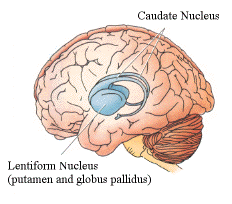
The caudate nucleus and the putamen, which together are called the striatum, take in messages from very complicated parts of the brain--those that control body movement, physical feelings, and the thinking and planning that involve those movements and feelings. They function in unison like an automatic transmission, assuring the smooth transition from one behavior to another. Typically, when anyone decides to make a movement, intruding movements and misdirected feelings are filtered out automatically so that the desired movement can be performed rapidly and efficiently. There is a quick, smooth shifting of gears.
During a normal day, we make many rapid shifts of behavior, smoothly and easily and usually without thinking about them. It is the functioning of the caudate nucleus and the putamen that makes this possible. In OCD, the problem seems to be that the smooth, efficient filtering and the shifting of thoughts and behavior are disrupted by a glitch in the caudate nucleus.
As a result of this malfunction, the front of the brain becomes overactive and uses excessive energy. It's like having your car stuck in a ditch. You spin and spin and spin your wheels, but without traction you can't get out of that ditch. With OCD, too much energy is being used in a frontal part of the brain called the orbital cortex. It's as if the orbital cortex, which has an error-detection circuit, becomes stuck in gear. This is probably why OCD causes people to get a "something is wrong" feeling that won't go away.
You have to do the work to get it out of gear--to shift the gears. You have a manual, rather than an automatic, transmission. In fact, the person with OCD has a sticky manual transmission; he or she must shift the gears. This takes great effort because the brain tends to get "stuck in gear." But, whereas an automobile transmission is made of metal and can't fix itself people with OCD can teach themselves how to shift gears through self-directed behavior therapy. In doing so, they can actually fix this broken gearshift in the brain. We now know that you can change your own brain biochemistry.
The key to the Reattribute step is to realize that the awful intrusiveness and ferocious intensity of OCD thoughts are due to a medical condition. Underlying problems in brain biochemistry are causing these thoughts and urges to be so intrusive. That is why they won't go away. By doing this Four-Step Method of self-directed behavior therapy, you can change the brain's biochemistry. This takes weeks or even months of hard work.
In the meantime, understanding the role the brain plays in OCD thoughts and urges will help you to avoid one of the most demoralizing and destructive things people with OCD almost invariably do: the frustrating attempt to "get rid of" the thoughts and urges. There is nothing you can do to make them go away immediately. But remember: You don't have to act on them. Don't take them at face value. Don't listen to them. You know what they are. They are false messages from the brain that are due to a medical condition called OCD. Use this knowledge to avoid acting on them.
The most effective thing you can do something that will help you change your brain for the better in the long run — is to learn to put these thoughts and feelings aside and go on to the next behavior. This is what we mean by shifting gears: Do another behavior. Trying to make them go away will only pile stress on stress--and stress just makes OCD thoughts and urges worse.
Using the Reattribute step will also help you to avoid performing rituals in a vain attempt to "get the right feeling" (for example, a sense of "evenness" or a sense of completion). Knowing that the urge to get that "right feeling" is caused by a biochemical imbalance in the brain, you can learn to ignore the urge and move on. Remember, "It's not me--it's my OCD." By refusing to listen to the urge or to act on it, you will actually change your brain and make the feeling lessen. If you take the urge at face value and act on it, you may get momentary relief but within a very short time the urge will just get more intense. This is perhaps the most important lesson that people with OCD must learn. It will help you avoid being the "sucker" and taking the false bait of OCD every time.
The Relabel and Reattribute steps are usually performed together to bring about a deeper understanding of what is really happening when an OCD thought or urge causes you such intense pain. You Relabel it, call it what it is--an obsession or a compulsion. Use mindful awareness to get beyond a superficial understanding of OCD and to gain the more profound understanding that the thoughts and urges are nothing more than fallout from a medical condition.
Step 3: Refocus
The Refocus step is where the real work is done. In the beginning, you may think of it as the "no pain, no gain" step. Mental exercise is like a physical workout. In Refocusing, you have work to do: You must shift the gears yourself. With effort and focused mindfulness, you are going to do what the caudate nucleus normally does easily and automatically, which is to let you know when to switch to another behavior.
Think of a surgeon scrubbing his hands before surgery: The surgeon doesn't need to wait for a timer to go off to know when it's time to stop scrubbing. After a while, the behavior is simply automatic. After a while he gets a "feel" for when he's scrubbed enough. But people with OCD can't get the feeling that something is done once it's done. The automatic pilot is broken. Fortunately, doing the Four Steps can usually fix it.
In Refocusing, the idea is to work around the OCD thoughts and urges by shifting attention to something else, if only for a few minutes. Early on, you may choose some specific behavior to replace compulsive washing or checking. Any constructive, pleasant behavior will do. Hobbies are particularly good. For example, you may decide to take a walk, exercise, listen to music, read, play a computer game, knit, or shoot a basketball.
When the thought comes, you first Relabel it as an obsessive thought or a compulsive urge and then Reattribute it to the fact that you have OCD — a medical problem. Then Refocus your attention to this other behavior that you have chosen. Start the process of Refocusing by refusing to take the obsessive-compulsive symptoms at face value. Say to yourself, "I'm experiencing a symptom of OCD. I need to do another behavior."
You must train yourself in a new method of responding to the thoughts and urges, redirecting your attention to something other than the OCD symptoms. The goal of treatment is to stop responding to the OCD symptoms while acknowledging that, for the short term, these uncomfortable feelings will continue to bother you. You begin to "work around" them by doing another behavior. You learn that even though the OCD feeling is there, it doesn't have to control what you do. You make the decision about what you're going to do, rather than respond to OCD thoughts and urges as a robot would. By Refocusing, you reclaim your decision-making power. Those biochemical glitches in your brain are no longer running the show.
Refocusing isn't easy. It would be dishonest to say that dismissing the thoughts and urges and moving on does not take significant effort and even tolerance of some pain. But only by learning to resist OCD symptoms can you change the brain and, in time, decrease the pain. To help you manage this task, we have developed the fifteen-minute rule.
The idea is to delay your response to an obsessive thought or to your urge to perform a compulsive behavior by letting some time elapse--preferably at least fifteen minutes--before you even consider acting on the urge or thought. In the beginning or whenever the urges are very intense, you may need to set a shorter waiting time, say five minutes, as your goal. But the principle is always the same: Never perform the compulsion without some time delay.
Remember, this is not a passive waiting period. It is a time to perform actively the Relabeling, Reattributing, and Refocusing steps. You should have mindful awareness that you are Relabeling those uncomfortable feelings as OCD and Reattributing them to a biochemical imbalance in the brain. These feelings are caused by OCD; they are not what they seem to be. They are faulty messages coming from the brain.
Then you must do another behavior~any pleasant, constructive behavior will do. After the set period has lapsed, reassess the urge. Ask yourself if there's been any change in intensity and make note of any change. Even the smallest decrease may give you the courage to wait longer. You will be learning that the longer you wait, the more the urge will change. The goal will always be fifteen minutes or more. As you keep practicing, the same amount of effort will result in a greater decrease in intensity. So, in general, the more you practice the fifteen-minute rule, the easier it gets. Before long, you may make it twenty minutes or thirty minutes or more.
It is vitally important to Refocus attention away from the urge or thought and onto any other reasonable task or activity. Don't wait for the thought or feeling to go away. Don't expect it to go away right away. And, by all means, don't do what your OCD is telling you to do. Rather, engage in any constructive activity of your choosing. You'll see that instigating a time delay between the onset of the urge and even considering acting on it will make the urge fade and change. What is more important, even if the urge changes hardly at all, as sometimes happens, you learn that you can have some control over your response to this faulty message from the brain.
This application of mindful awareness and the Impartial Spectator will be empowering to you, especially after years of feeling at the mercy of a bizarre and seemingly inexplicable force. The long-range goal of the Refocus step is, of course, never again to perform a compulsive behavior in response to an OCD thought or urge. But the intermediate goal is to impose a time delay before performing any compulsion. You're learning not to allow OCD feelings to determine what you do.
Sometimes the urge will be too strong, and you will perform the compulsion. This is not an invitation to beat yourself up. Keep in mind: As you do the Four Steps and your behavior changes, your thoughts and feelings will also change. If you give in and perform a compulsion after a time delay and an attempt to Refocus, make a special effort to continue to Relabel the behavior and to acknowledge that this time the OCD overwhelmed you. Remind yourself "I'm not washing my hands because they are dirty, but because of my OCD. The OCD won this round, but next time I'll wait longer." In this way, even performing a compulsive behavior can contain an element of behavior therapy. This is very important to realize: Relabeling a compulsive behavior as a compulsive behavior is a form of behavior therapy and is much better than doing a compulsion without making a clear mental note about what it is.
A tip for those who are fighting checking behaviors--checking locks, stoves, and other appliances: If your problem is, say, checking the door lock, try to lock the door with extra attention and mindful awareness the first time. This way, you'll have a good mental picture to refer to when the compulsive urge arises. Anticipating that the urge to check is going to arise in you, you should lock the door the first time in a slow and deliberate manner, making mental notes, such as "The door is now locked. I can see that the door is locked." You want a clear mental image of that locked door; so when the urge to check the door seizes you, you will be able to Relabel it immediately and say, "That's an obsessive idea. It is OCD." You will Reattribute the intensity and intrusiveness of the urge to check again to your OCD. You will remember, "It's not me--it's just my brain."
You will Refocus and begin to "work around" the OCD urges by doing another behavior, with a ready mental picture of having locked that door because you did it so carefully and attentively the first time. You can use that knowledge to help you Refocus actively on doing another behavior, even as you Relabel and Reattribute the urge to check that has arisen, as you anticipated it would.
It is important to keep a behavior-therapy journal as a record of your successful Refocusing efforts. It need not be anything fancy. The idea is simply to have a written record to remind you of your successes in self-directed behavior therapy. The journal is important because you can refer back to it to see which behaviors most helped you to Refocus. But — and this is equally important — it helps you to build confidence as you see your list of achievements grow. In the heat of battle against a compulsive urge, it isn't always easy to remember which behavior to Refocus on. Keeping a journal will help you to shift gears when the going gets tough, when the obsessive thought or compulsive urge heats up, and will train your mind to remember what has worked in the past. As your list of successes gets longer, it will be inspirational.
Record only your successes. There is no need to record your failures. You have to learn to give yourself a pat on the back. This is something people with OCD need to learn to do more of. Make sure to give yourself encouragement by consciously acknowledging your successful use of Refocusing behaviors as a job well done. Reinforce that success by recording it in your behavior-therapy journal and giving yourself a little reward, even if it's only to tell yourself how terrific you are for working so hard to help yourself.
Step 4: Revalue
The goal of the first three steps is to use your knowledge of OCD as a medical condition caused by a biochemical imbalance in the brain to help you clarify that this feeling is not what it appears to be and to refuse to take the thoughts and urges at face value, to avoid performing compulsive rituals, and to Refocus on constructive behaviors. You can think of the Relabel and Reattribute steps as a team effort, working together with the Refocusing step.
The combined effect of these three steps is much greater than the sum of their individual parts. The process of Relabeling and Reattributing intensifies the learning that takes place during the hard work of Refocusing. As a result, you begin to Revalue those thoughts and urges that, before behavior therapy, would invariably lead you to perform compulsive behaviors. After adequate training in the first three steps, you are able in time to place a much lower value on the OCD thoughts and urges.
We have used the concept of the "Impartial Spectator," developed by 18th-century philosopher Adam Smith, to help you understand more clearly what you are actually achieving while performing the Four Steps of cognitive biobehavioral therapy. Smith described the Impartial Spectator as being like a person inside us who we carry around at all times, a person aware of all our feelings, states, and circumstances. Once we make the effort to strengthen the Impartial Spectator's perspective, we can call up our own Impartial Spectator at any time and literally watch ourselves in action. In other words, we can witness our own actions and feelings as someone not involved would, as a disinterested observer.
As Smith described it, "We suppose ourselves the spectators of our own behavior." He understood that keeping the perspective of the Impartial Spectator clearly in mind, which is essentially the same as using mindful awareness, is hard work, especially under painful circumstances, and requires the "utmost and most fatiguing exertions.". The hard work of which he wrote seems closely related to the intense efforts you must make in performing the Four Steps.
People with OCD must work hard to manage the biologically induced urges that intrude into conscious awareness. You must strive to maintain awareness of the Impartial Spectator, the observing power within that gives you the capacity to fend off pathological urges until they begin to fade. You must use your knowledge that OCD symptoms are just meaningless signals, false messages from the brain, so you can Refocus and shift gears.
You must gather your mental resources, always keeping in mind, "It's not me--it's my OCD. It's not me--it's just my brain." Although in the short run, you can't change your feelings, you can change your behavior. By changing your behavior, you find that your feelings also change in time. The tug-of-war comes down to this: Who's in charge here, you or OCD? Even when the OCD overwhelms you, and you give in and perform the compulsion, you must realize that it's just OCD and vow to fight harder the next time.
With compulsive behaviors, simply observing the fifteen-minute rule with consistency and Refocusing on another behavior will usually cause the Revalue step to kick in, which means realizing that the feeling is not worth paying attention to and not taking it at face value, remembering that it's OCD and that it is caused by a medical problem. The result is that you place a much lower value on--devalue--the OCD feeling. For obsessive thoughts, you must try to enhance this process by Revaluing in an even more active way.
Two substeps — the two A's — aid you in Step 2: Reattribute: Anticipate and Accept. When you use these two A's, you are doing Active Revaluing. Anticipate means "be prepared," know the feeling is coming, so be ready for it; don't be taken by surprise. Accept means don't waste energy beating yourself up because you have these bad feelings. You know what's causing them and that you have to work around them. Whatever the content of your obsession--whether it is violent or sexual or is manifested in one of dozens of other ways--you know that it can occur hundreds of times a day.
You want to stop reacting each time as though it were a new thought, something unexpected. Refuse to let it shock you; refuse to let it get you down on yourself. By anticipating your particular obsessive thought, you can recognize it the instant it occurs and Relabel it immediately. You will simultaneously, and actively, Revalue it. When the obsession occurs, you will be prepared. You will know, "That's just my stupid obsession. It has no meaning. That's just my brain. There's no need to pay attention to it."
Remember: You can't make the thought go away, but neither do you need to pay attention to it. You can learn to go on to the next behavior. There is no need to dwell on the thought. Move ahead. This is where the second A--Accept--comes in. Think of the screaming car alarm that disturbs and distracts you. Don't dwell on it. Don't say, "I can't do another thing until that blankety-blank car alarm shuts off." Simply try to ignore it and get on with things.
You learned in Step 2 that the bothersome obsessive thought is caused by OCD and is related to a biochemical imbalance in the brain. In the Acceptance substep of Reattributing, you realize that truth in a very deep, perhaps even spiritual, way. Do not get down on yourself. it makes no sense to criticize your inner motives just because of an imbalance in the brain. By accepting that the obsessive thought is there despite you, not because of you, you can decrease the terrible stress that repetitive obsessive thoughts usually cause. Always keep in mind, "It's not me — it's the OCD. It's not me — it's just my brain." Don't beat yourself up trying to make the thought go away because in the short run, it will not. Most important, don't ruminate and don't fantasize about the consequences of acting out a terrible obsessive thought.
You won't act it out because you don't really want to. Let go of all the negative, demeaning judgments about "the kinds of people who get thoughts like this." For obsessions, the fifteen-minute rule can be shortened to a one minute rule, even a fifteen-second rule. There is no need to dwell on that thought, even though it lingers in your mind. You can still go on--indeed, you must go on — to the next thought and the next behavior. In this way, Refocusing is like a martial art. An obsessive thought or compulsive urge is very strong, but also quite stupid. If you stand right in front of it and take the full brunt of its power, trying to drive it from your mind, it will defeat you every time. You have to step aside, work around it, and go on to the next behavior. You are learning to keep your wits about you in the face of a powerful opponent. The lesson here goes far beyond overcoming OCD By taking charge of your actions, you take charge of your mind — and of your life.
Conclusion
We who have OCD must learn to train our minds not to take intruding feelings at face value. We have to learn that these feelings mislead us. In a gradual but tempered way, we're going to change our responses to the feelings and resist them. We have a new view of the truth. In this way, we gain new insights into the truth. We learn that even persistent, intrusive feelings are transient and impermanent and will recede if not acted on.
And, of course, we always remember that these feelings tend to intensify and overwhelm us when we give in to them. We must learn to recognize the urge for what it is--and to resist it. In the course of performing this Four-Step Method of behavioral self-treatment, we are laying the foundation for building true personal mastery and the art of self-command. Through constructive resistance to OCD feelings and urges, we increase our self-esteem and experience a sense of freedom. Our ability to make conscious, self-directed choices is enhanced.
By understanding this process by which we empower ourselves to fight OCD and by clearly appreciating the control one gains by training the mind to overcome compulsive or automatic responses to intrusive thoughts or feelings, we gain a deepening insight into how to take back our lives. Changing our brain chemistry is a happy consequence of this life-affirming action. True freedom lies along this path of a clarified perception of genuine self-interest.
Step 1: RELABEL Recognize that the intrusive obsessive thoughts and urges are the RESULT OF OCD.
Step 2: REATTRIBUTE Realize that the intensity and intrusiveness of the thought or urge is CAUSED BY OCD; it is probably related to a biochemical imbalance in the brain.
Step 3: REFOCUS Work around the OCD thoughts by focusing your attention on something else, at least for a few minutes: DO ANOTHER BEHAVIOR.
Step 4: REVALUE Do not take the OCD thought at face value. It Is not significant in itself.
Source: "Brain Lock," by J. Schwartz, Regan Books, 1996. More information.
Dr. Jeffrey Schwartz' Four Steps for OCD are a great self-help technique, but if your OCD is severe, you may need professional help. If you are still struggling with OCD after trying the 4 Steps, contact us for a consultation.
Contact Us For A Consultation
Further Reading: Mindfulness and OCD
The Use of Mindfulness in the Treatment of Obsessive Compulsive Disorder (OCD)
by Dr. Jeffrey Schwartz
There are very effective treatments available for treating obsessive compulsive disorder, and the suffering from the symptoms can be very profound - even to the point where people seriously contemplate ending their lives through suicide in an attempt to escape them.
There are now ways to treat this disorder effectively, combining both the use of medication as well as things you can learn to do with your mind itself. Mental training can be really effective in helping people with obsessive compulsive disorder change not only their functioning and the pragmatic clinical course of the disorder, but also as we're going to see change the brain itself.
This brings us to the second aspect, perhaps as important as the first: the profound implications of medical science demonstrating that what people do with their mind affects how the brain works. I see it as our mission going forward as a society to increasingly have people realize that how you focus your attention, and what you focus your attention on, has very significant effects on how your brain works.
I think that in the materialist culture that the 20th century bequeathed us there is a tendency for people to view themselves as just passive recipients of their own mental contents. Essentially viewing themselves as almost like machines, people can come to believe there is nothing very much you can do about your troublesome feelings unless you take some drug, and that you're basically doomed to more or less to sit there experiencing the affects of a problem like OCD until someone finds a drug to make it better.
Now in no way am I implying that medications are not very helpful in treating neuropsychiatric conditions with a clear cut biological basis, such as obsessive compulsive disorder. However I think that to go forward as a medical community and as a society we need to realize that the materialist approach not only to mental and physical health, but even to life itself, tends to strip us of our capacity to connect with the power we all have within us. And it is this power, with which we are all endowed, that enables us to bring about tremendous changes in the way we live and even the way our brain works.
I think its relatively clear, if you just think about the implications of all this, that it can have profound societal effects in terms of issues of personal responsibility. Actions truly have consequences not only in the most ordinary way of how they affect other people but even how it affects your brain and how it works. This is the big message going forward and the great implications it has for treating mental health problems, and medical disorders in general, are extremely important.
In the next few minutes I'm going to try to explain to you how much the symptoms of this condition can be understood as a brain related medical problem. The first point is that people with obsessive compulsive disorders have increased metabolism, or another way of saying the same thing is excessive energy use, in a specific region of their brain. This excessive energy sits right over the eye orbit or the eye socket, an area of the brain called the orbital frontal cortex. There is a picture of this in my book Brain Lock on the back cover and on page xxiii.
It is well known from a lot of neurobehavioural research that this part of the brain is involved in people making emotional assessments of their environment. More specifically, it is involved in getting the feeling that something isn't right in the environment, or what we can sometimes call an error detection signal. The big point is that people with obsessive compulsive disorder have shown increases in metabolism in this part of the brain that gives one the feeling that something is wrong. This part of the brain is really overactive in people with OCD.
There is almost certainly a connection between that biological change and for instance the description we just heard of feeling like you live in a dump, and the reason why the bothersome feeling doesn't go away is just because the brain is overactive.
Another important brain structure for understanding OCD is the caudate nucleus. There is a picture of it on page 59 of Brain Lock. The caudate nucleus is like an automatic transmission in the brain. What is happening and where the term brain lock comes from, is that an error detection circuit that's contained in the orbital frontal cortex literally gets locked in gear. The result is you are bombarded with these very bothersome troubling feelings.
This is the situation in overview--at the bottom of the front of the brain is the orbital frontal cortex, which can send error detection signals. It sends its signals by a direct connection to the caudate nucleus, which acts like an automatic transmission. Largely because of biologically inherited traits the caudate nucleus gets stuck in gear again and again and again and these very bad thoughts, these bothersome troubling thoughts, keep bombarding into the persons conscious awareness.
Now what can one do about this? The really good news is that there is a lot that can be done about this problem. While it is quite common, affecting one person in forty in the general population, there is also a huge amount of data that it is a very treatment responsive illness.
There are certainly medications that can help with the treatment process. What those medications do is actually act on the neurochemical transmitter serotonin, which is very widespread throughout the brain, particularly in that caudate nucleus and orbital frontal cortex area. By modulating serotonin levels in the brain, the medications over a period of several months bring down the intensity of the intrusive bothersome feelings.
We can also change the activity in those very same structures of the brain by learning how to redirect our attention and the way to redirect our attention is largely a function of a mental process called mindfulness. This has profound philosophical significance and was first described 2500 years ago by Gotama Buddha.
Mindfulness is the foundation of Buddha's philosophy and of the practice of meditation. However, when used as a form of mental development for something like treating OCD, it has no religious content at all. This is really important to stress--nothing in the use of mindfulness would ever impinge on the religious beliefs of any other religion. Even though in some sense it has what you might call a spiritual content, this is in a general sense of having the mind influence the brain.
Mindfulness as a mental action is described in the abstract in the conference program book (which I have attached as an appendix at the end of this paper). I really encourage you to read the abstract to have a record to refer back to. Understand that mindfulness is an action in which you learn and train yourself to direct your attention in a wholesome and healthy manner.
Mindfulness is a training process to observe your inner experience with calm and with a feeling of clarity. Observing the inner experience calmly, clearly and without responding to it. For instance in the case that we just heard one would make mental notes reminding oneself that although the experience is very unpleasant, it is not something that one needs to worry about in terms of taking over control of one's mind. The process of observing in itself helps people increasingly come to the realization that they can change their responses to those thoughts in very adaptive ways.
The Four Steps are the basis of the treatment approach presented in the book Brain Lock (they are listed in a chart on page 219). The term brain lock refers to the error detection circuit that is locked in the on position. The Relabel step, which is the first step and recognizes the intrusive thoughts and urges as nothing but the symptoms of OCD, is essentially the equivalent of what I have just described as mindfulness. Another way of thinking of the Relabeling step is called "making mental notes."
What you want to train your mind to do in the Relabel step is to recognize that the reason why you feel like you do when you are having on OCD symptom is simply because of a medical condition, a treatable medical condition. What this does is begin to put things in a real life perspective. You can begin to understand why your consciousness is being bombarded by such bothersome experiences.
We are now taking advantage of advancements in medical science, which have shown us without a doubt that there are brain mechanisms that are responsible for those feelings being there. Then we are coupling that to a traditional process of mental observation. We are using that traditional process of clear-minded mental observation to really put in a context why these thoughts are bothering us so much--because we have a treatable medical condition. The second step answers the question why does it keep bothering us.
The first step is to Relabel. We put an accurate notation in our own mind that answers the question, "What is this that's bothering me?" and the answer is a treatable medical condition, OCD. In fact this process works equally well for panic attacks, panic disorder, social phobia and essentially all the anxiety disorders.
We must realize that the feeling itself is not what is important, it is our understanding of the fact that we can mindfully observe the feeling and thereby change our responses to it. This will make us well and make our minds more powerful and even change the underlying chemistry of our brain in ways that move us toward the healthy path.
So the second step, Reattribute is answering the question, "Why do they keep bothering me?" The thing that really makes them debilitating is that they don't go away, they keep bothering you and bothering you. The answer to that question is that the intensity and intrusiveness of the thought or urge is caused by the medical condition OCD, and it's probably the result of a biochemical imbalance in the brain. So you attribute the bad feeling to OCD and stop blaming yourself for it.
We then came up with this little aphorism that a patient actually said, "it's not me it's the OCD". Now that has a lot to do with mindfulness because it's mindfulness that is allowing you to see clearly that you are not the disease and that your mind and your consciousness are not the disease process. There is an observing aspect of the mind that can really maintain its independence even though the contents of the consciousness are being flayed around by the disease process. We are really training the mind to not identify with those experiences but to see ourselves as separable from those experiences.
Now once we see our mind as separable from those experiences we can go on to the critical third step. This step, called Refocus, actually changes how the brain works. In the Refocus step the critical key phrase is "work around." Work around, I am using as a technical term. Work around the OCD symptoms by focusing attention on something else by doing something else and the key phrase here is do another behaviour. The term "work around" means don't wait for the feeling to go away--Work Around it by doing another behaviour, even though the feeling is still bothering you.
Now why is that so important? The reason why work around is a technical term is because the hard part of this treatment that really requires will and stick-to-it-iveness and courage is remembering that you can't make those feelings go away in the short term. You really are working around them, and in that way its like an obstacle course.
You have to go over or around or any way you can get past getting locked into compulsive behaviours like washing and checking. You remind yourself I want to do something useful, and generally what you want to do is something that you like to do that's both familiar and useful.
When you do this on a regular basis you literally change the gearbox shifting capacity of the caudate nucleus. What you have happen is that the gearbox now starts shifting to good behaviours. Because of the underlying medical disease process it won't shift to the good behaviours unless you literally shift it yourself by refocusing your attentions willfully on an adaptive behaviour. The key phrases are do another behaviour while working around the fact that the bothersome thoughts and urges are still there.
The most important rule of thumb for this critical step is not to try to make the thoughts go away, because in the short term that's something you can't do. There are powerful brain mechanisms going on and that's where people need a lot of support with this treatment. There is a natural tendency to want to make these symptoms just go away. However you have to accept the fact that the symptoms are there but realize with mindfulness that they don't have to control what you do. This is why we say "It's not how you feel it's what you do that counts," and that's such an important principle for life.
In practice this means that if you want to change how you feel you have to do good things. If you put all of the focus of your attention on doing good things, your feelings will naturally follow. If you put too much of your attention on how you feel then you get a lot of emotional responses because you are too wrapped up in your feelings, and things can just spiral into becoming more and more intense and out of control.
Now when you do things in the proper way and put your attention on your action what ends up happening is that you really come to Revalue which is step four and is the last step of this process. It can often take several weeks or months to kick in. Revalue means that you really learn not to take the OCD or what ever anxiety symptom we're talking about at face value. Instead you literally recognize the feeling in a different way. This is the most powerful part of mindfulness because with mindfulness you can literally have the same feeling but have a totally different meaning than it did before you were mindful.
So it is not the feeling that needs the change, it is your understanding of the truth that needs to change. As your understanding of the truth develops then this feeling that I need to wash, I need to check, I can't breathe if it's a panic attack, whatever the phobia might be changes. The key is to put a different value on that feeling and say "oh well that's just the symptom, that's just the medical symptom I don't need to listen to that I'm going to refocus and do an adaptive behaviour." Yes it takes mindfulness. Yes it takes mental strength. But it's a powerful process with powerful results.
When you do this it literally changes your brain in a very significant way. You literally have used your mind to change your brain. We can also use the standard medications, the so-called Serotonin Reuptake Inhibitors to change the activity in the gearbox in ways that are helpful. As we said before the medications change the activity in the gear box and the feelings do decrease on account of that.
I'm more than happy to use medications in people for whom they are appropriate, and in more than half the people with significant OCD they are appropriate at least in some course of the treatment. The fact that is so encouraging for us that you can cause those same changes to occur in the metabolism of the gear box by using just your mind and its capacity to refocus on a new behaviour.
With the learning of new and better habits, and the new patterns of focusing attention, you literally see biological changes in the area of the brain that functions as the gearbox. I strongly believe this lowers the need for medications, too, although much more research needs to be done on this aspect of treatment. I think all of the clinicians here at the conference would agree that when people do the cognitive behaviour therapy there is often a progressive decrease in the amounts of medication that are needed.
Slowly over time you can see people needing less medication than they would if they did not do the cognitive behaviour therapy. I would strongly urge clinical researchers in the field to really pursue this hypothesis in a systematic way. I think it would be really good to collect more data that says as people work on cognitive behaviour therapy and change how their brain works their requirement for medication decreases along with that. Already we have a lot of clinical evidence that this is true.
This is very helpful and it's also financially helpful too. It's certainly helpful on the side effect picture. But another point that is even more important is that we are now empowered and we realize that our mind has real power to affect how our brain works.
The focus of our will through the utilization of refocusing of our attention and doing another behaviour empowers us to change inborn pathological circuitry in the brain. In that message I think comes an awareness that can really affect our entire culture in terms of the power of mindfulness to change not only our lives but even the inner workings of our brain. Thank you very much.